






The automobile! Arguably the defining invention of the 20th century, the production of which shapes whole economies. As is the case with any technology, cars are the focus of a considerable amount of public policy. However, real-world policy makers are limited by such plebian concerns as “is this even possible” and “will I manage to stay in office if I introduce this regulation?” Thus, for truly visionary solutions, one must turn to SF authors.
Consider these five traffic issues.
Traffic Jams
Who among us has not been caught in traffic jam? Even I, who do not drive, have found myself in a stationary vehicle, trapped in a mass of unmoving cars1. Traffic jams have been a driving hazard since at least November 11, 1921, when an Armistice-Day-related incident left 3000 cars motionless. Since then, great advances have been made: in 2010, for example, China experienced almost two weeks of gridlock stretching over 100 kilometers of the Beijing-Tibet Expressway.
How to manage this issue?
James D. Houston’s 1964 story “Gas Mask” proposed a surprisingly workable approach. Commuter Charlie Bates is caught up in a vast, seemingly endless traffic jam. Air quality plummets and of course certain basic necessities are not available within motionless cars. Bates’ breakthrough is to accept that there is no solution, the jam may never end, and to adjust his lifestyle to that reality.
Crash Safety
It might be possible to make crashes extremely rare. However, the more people out on the road, the more chances there are for unlikely events to occur. Therefore, even if superhuman efforts are made to ensure that crashes are as infrequent as possible, the number will never be zero. Car design must take that into account.
Gerry & Sylvia Anderson’s TV series Captain Scarlet and the Mysterons (1967–1968) featured an especially trying traffic context, given the Mysteron enthusiasm for engineering disasters as part of their convoluted revenge plot2. The Spectrum Pursuit Vehicle design reflected this: drivers sat in rearward-facing seats, steering the windowless car via telescreen images3. This would mitigate the effects of sudden deceleration on the SPV’s driver… although not on any pedestrians who got in the way.
Speed and Distance
Simple logic suggests that the less time one spends on the road, the fewer the opportunities for mishaps. There are only two factors that determine how long one is on the road: speed and distance between origin and destination. SF authors have tackled both.
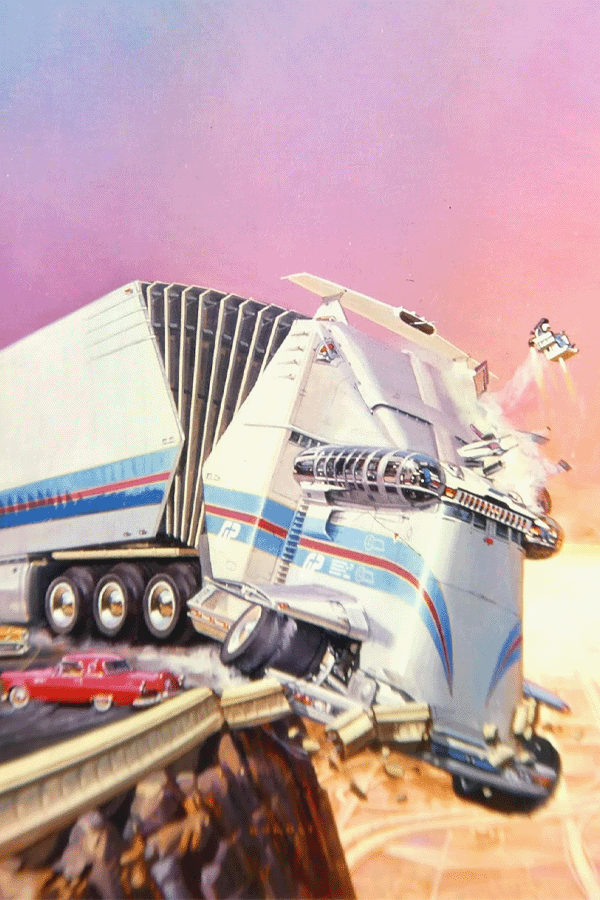
Rick Raphael’s 1963 Code Three offers a vision of a North America spanned by an advanced road system able to handle speeds of up to four hundred miles an hour. Alas, this vast improvement in speed is not matched to any commensurate improvement in driving skills. Therefore, it falls to the brave, often short-lived North American Thruway Patrol officers to keep the carnage to acceptable levels.
No mundane improvement in speed would suffice in John DeChancie’s 1983 Starrigger. The starrigger routes cover interstellar distances. Conveniently, the so-called tollbooths (AKA Kerr-Tipler objects) scattered by a previous civilization solve the problem. Provided that the trucks survive passage through warped spacetime, they can simply drive from one planet to another as easily as we drive from Toronto to Montreal… if for some reason the 401 were to be subject to metal-shredding tidal forces.
Autonomous Vehicles
Even the best human is flawed. Human drivers ensure human error. Human error leads to mishaps. Removing humans from the equation removes the human element leading to accidents. That’s just simple logic, the sort of reasonable conclusion any Skynet or Colossus might come to.
Among the many benefits offered by the Unification Council in Daniel Keys Moran’s 1989 The Long Run is Automated Traffic Control. Under the system’s watchful eye, passengers could be assured trips would be as safe as possible, not to mention completely documented by the world government. Only a handful of so-called “speedfreaks” objected. The manifest absurdity of their position was made clear when a million-car convoy attempting to circumnavigate the Earth in manually-driven hovercars flew into a storm and perished4.
Communication
Automobiles possess only rudimentary systems for communicating with other vehicles: blinkers, shouts, the one-fingered Mudra of Contempt, and so on. Improved clarity could only improve the situation. No gesture’s meaning is as clear as a gunshot; therefore, arming cars is an obvious possibility.
Alan Dean Foster’s 1971 story “Why Johnny Can’t Speed” offers a utopian vision of a North America in which prudent drivers cruise the streets in heavily armed, heavily armoured cars, ever ready to use lethal violence to prove their right to be on the road. Tragically, Frank and Myrt Merwin’s son Robert prioritized maneuverability over armour or firepower. Frank cannot bring Robert back to life, but he can get a father’s just revenge5.
Perhaps you have your own favourite science-fictional solutions to the opportunities presented by cars. If so, share them in comments.
- As I live in KW, I’ve also found myself in a stationary Ion, thanks to the tendency of local drivers to steer into or otherwise impede the Ion. The Ion is our light rail system, which I am sad to say uses neither ions nor rails made from light. ↩︎
- The Mysterons were annoyed by the high-handed manner in which Earth’s Captain Black (in an excess of caution) blew an entire city off the face of Mars. Annoying a vastly superior, exceptionally vindictive civilization turns out to be a bad idea. ↩︎
- Designers clearly had a lot of faith in the reliability of SPV cameras and telescreens. ↩︎
- Those who survived received death sentences and lengthy jail terms, as was the custom at the time. An interesting setting detail that I mention for no particular reason: The Long Run’s UN had weather control technology at their disposal. ↩︎
- Did Steve Jackson Games’ Car Wars ever cite its inspirations? Were either “Why Johnny Can’t Speed” or Ellison’s “Along the Scenic Route” among them? ↩︎

Real life has utterly failed to afflict cars with the number of harpoon wielding joy-riders attempting to catch a ride as sci-fi prepared me for. eg YT in Snow Crash uses a “‘poon” to catch a ride, and Mad Max
Ada Palmer’s Terra Ignota series also has a network of autonomous super-sonic flying cars, and this has had a strong effect on her world. Although I did find myself wondering where the bicycles, groundcars, and trains were: there are plenty of transportation use cases where a supersonic flying car is overkill (do I really need a vehicle that can take me anywhere in the world in an hour, to go five miles across town?) or otherwise unsuitable (as described in the books they seem optimized for moving passengers and not cargo).
(Two networks, actually, but one of them is a bit restricted.)
I had an edition of Car Wars many years ago that did cite some influences, and if memory serves me right both the Foster and the Ellison were indeed mentioned.
Traffic Jams: Can’t remember either the title or author, but there was a story in Omni back in the 1980s where LA DOT responds to a multi-day jam on one of the freeways by a) throwing up barriers to discourage drivers from abandoning their vehicles; b) airdropping cyanide pills shortly before pouring concrete over the trapped cars.
Scary!
I remember that story! But not the title or author.
That’s “The Great Moveway Jam” by John Keefauver, from the March 1979 issue of Omni.
According to https://en.wikipedia.org/wiki/Car_Wars#Publication_history Car Wars did cite its inspirations including Why Johnny Can’t Speed. There’s no citation for that though.
Citation: my battered old pocket box copy of the game. :) Not that Wikipedia would accept a scan of that.
Also Roger Zelazny’s Damnation Alley, Devil Car, and Last of the Wild Ones, and “Every James Bond movie ever made.” I probably had the same edition, in the little black plastic box.
You missed a prime opportunity for referencing cross-media CanCon:
Rush’s /Red Barchetta/ (1981, Moving Pictures) is the songification of the 1973 short story “A Nice Morning Drive” published in that hotbed of subversive SFnal content, Road & Track.
To quote wikipedia:
The story describes a similar future in which increasingly stringent safety regulations have forced cars to evolve into massive Modern Safety Vehicles (MSVs), capable of withstanding a 50-mile-per-hour (80 km/h) impact without injury to the driver. Consequently, drivers of MSVs have become less safety-conscious and more aggressive, and “bouncing” (intentionally ramming) the older, smaller cars is a common sport among some.
Surely someone else must remember “The Test” by Theodore L. Thomas about a future driving test.
There was a whole subgenre of “things that inspired Car Wars” in magazines at the time, I got a stack of them at our library’s “stuff we’re getting rid of” sales cart in high school. I vividly remember parts of Why Johnny Can’t Speed, as well as another story the name and author of which I no longer recall, but you could get in trouble for driving below the speed limit and at the end of the story they demolished the Empire State Building to make room for more roads.
That’s “Traffic Problems” by William Earls, from the October 1970 issue of Galaxy.
I was beginning to think it possible, as I read, that you weren’t going to mention “Why Johnny Can’t Speed”. I should have had stronger faith.
That said, to be fair to Robert, his strategy didn’t rely exclusively on maneuverability but also on there being enormous numbers of other Volkswagen drivers on the roads, who would be honour-bound to join his side of the fight if he were attacked.
How about Robert Heinlein’s short story, “The Roads Must Roll”? Cities connected by giant conveyor belts, all serviced by good union men – what could possibly go wrong?
Of course, its functionality is similar to railways in that it’s a means of transportation best suited to work between large population centres and less so for the hinterlands. The discovery of the ‘freedom’ provided by the personal automobile was stronger, at least here in North America.
I have read Code Three; at least for me, the most memorable part of the story was the Thruway Patrol’s service vehicle, which combines elements of a police car, ambulance, construction vehicle, mobile home, hovercraft, and tank.
With regard to the first solution, the Doctor Who episode “Gridlock” featured a traffic jam where the drivers’ movements could be measured in years.
Franson’s “Shell Shock” (from 1974) has cars that are virtually indestructible, making passengers very safe indeed. So safe, that anxious drivers feel a strange reluctance to ever get out of them.
In the context of traffic jams, I must mention Gene Wolfe’s “Bluesberry Jam,” about a young folk singer who lives in a continent-spanning TJ that never got moving again, and whose inhabitants depend on government largesse (in the form of supply drops from helicopters) to survive.
If we’re plugging traffic-related stories in general, my story “Early Warning Systems,” exclusive to my collection Aleyara’s Descent and Other Stories, involves the identification of time travelers through their tendency to get in accidents due to forgetting that cars in the past didn’t have collision avoidance systems.
Thank you for proving that there is another human on the planet that has read The Long Run. I reread it at least once per year.
I would like to point out that in the book it is heavily implied that not only did the govt fail to control the weather to avoid the convoy, but in fact generated and steered the storm into the convoy’s path.
I am reminded of the humungous traffic systems in Mega City One (Judge Dredd) wherein people are born, live and die in their vehicles.
Almost a century ago, David H Keller put those blasted automobile drivers (whose legs had atrophied over centuries of disuse) in their place through “The Revolt of the Pedestrians” (Amazing Stories, February 1928).
”Putting them in their place” meaning wiping out the Automobilists – who admittedly had been attempting to wipe out the Pedestrians. Somehow this seemed quite acceptable in 1920s SF…..
“Sometimes a little genocide is needed” isn’t rare in pre-WWII SF.
Market Forces by Richard K. Morgan – Climbing the corporate ladder means participating in sanctioned road-duels with weaponized cars.
I am reminded both of how Magnus, Robot Fighter’s girlfriend got her start as a robot resistor by driving her car by herself and of an old newspaper comic strip, “The Jackson Twins,” where one of the twin’s boyfriend was an inventor. One device was set to pop out of one’s car trunk/boot to encourage tailgaters to move farther back. (As for the speed freaks, why not let them have races on race tracks at their own risk?)